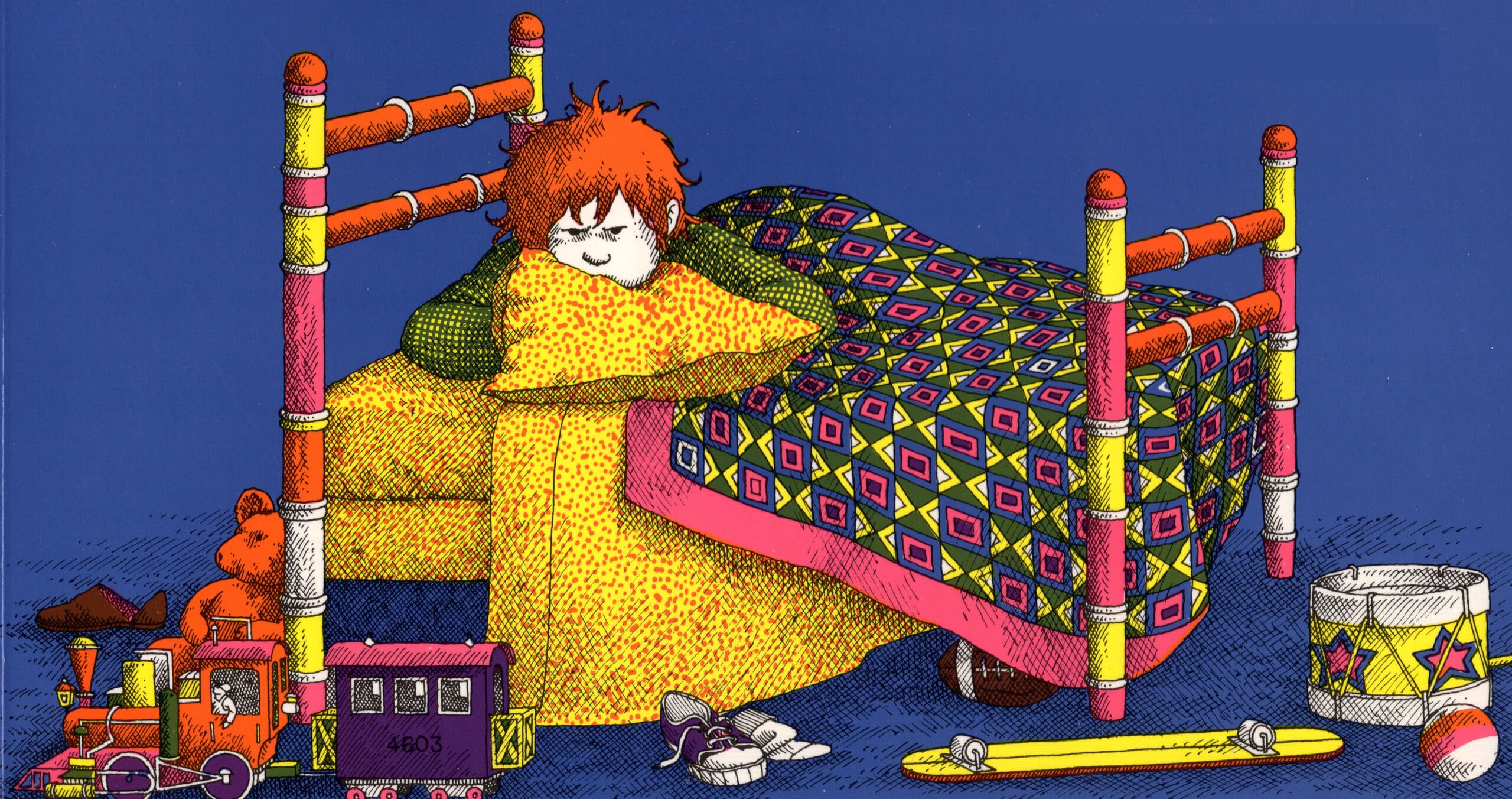
This is Alexander. I was introduced to him by the young lady I dated my freshman year in college. He’s not a real boy, but, then again, in a lot of ways he is. Created by author Judith Viorst in 1972 and named after her own youngest son, Alexander struggles with the reality that some days life just stinks. The first of Viorst’s four Alexander books, Alexander and the Terrible, Horrible, No Good, Very Bad Day has sold over 2 million copies, because, after all, which of us hasn’t ever had one of those? Alexander’s solution for addressing his situation is simple: go to Australia, because apparently they don’t have terrible, horrible, no good, very bad days in Australia. In the end, Alexander learns that some days are just like that, even in Australia (as I’m sure my Aussie friends will attest).
I had never heard of this book before my girlfriend showed it to me. She was an elementary education major, so while I was wrestling with theology and New Testament Greek, she was engrossed in the philosophical musings of a first-grader who believes life is better in Australia. To be fair, both of us had a flair for the melodramatic, so I identified with and enjoyed reading about Alexander’s predicament as much as she did. Truth be told, I was envious that her homework assignments seemed to be much more entertaing than mine. As I’m sure you can imagine, complaining about our terrible, horrible, no good, very bad days and threatening to go to Australia became staples in our relationship. It was a lot of fun.
Then she dumped me.
To this day, I can’t really tell you why. Not because I’m so adorable that I can’t imagine why anyone would break up with me, but because she never gave me a reason. What I can tell you is that, on that fateful day, I was forced to get a hair cut because I had been told I would be in violation of the school’s conservative dress code policy and disciplined if I didn’t. I didn’t have a car and couldn’t find anyone who would drive me to the barber shop, so I had to walk the two miles there and back. It was in West Virginia, so yes, I legitimately had to go uphill both ways. On the way back, it rained. When I returned to the dorm, tired, frustrated, and soaked, a buddy greeted me at the door with the message that my girlfriend wanted to talk to me. However, that wasn’t exactly true, because when I tracked her down, she refused to say anything other than it was over.
It was a terrible, horrible, no good, very bad day. I cannot tell you how much I wanted to go to Australia.
You might think that would have soured me against Alexander as well, but it had the opposite effect. Alexander became a symbol of the fact that, as rotten as that day was, not all days are terrible, horrible, no good, very bad ones. Some — dare I even say most — are wonderful, delightful, amazing, very good days. The thing is, I tend to focus on the bad rather than the good because I’m a pessimist by nature. In fact, I’m fond of saying that the problem with optimists is that they can never be pleasantly surprised. Yes, it is ironic for a guy like me to talk about hope as much as I do, but all that proves is a) how much I need it and b) how great a sense of humor God has.
So I keep what I call my Alexander File. In it, I store notes of encouragement that people have given me throughout the years and mementos of people, places, and events which always bring a smile to my face. On my terrible, horrible, no good, very bad days, I take a couple minutes to thumb through my Alexander File to reset my perspective and remember what a wonderful, delightful, amazing, very good God I have, because He’s the one who has showered my life with so many beautiful things to look back on. It’s gotten so substantial that I’m considering converting it into a scrapbook or two. And right in front is my own copy of Alexander and the Terrible, Horrible, No Good, Very Bad Day.
Over my next several posts, I’m going to share some of the stories that are memorialized in my Alexander File in the hope that doing so might inspire you to create an Alexander File of your own. You see, hope was meant to be shared. As encouraging as my Alexander File is to me, the real power in those memories comes from relating them to others. How else would you explain why a simple, 30-page, children’s book sold 2 million copies?
So here’s a prompt to help you get going. I can’t wait to read your replies.
What is the first thing you would put in your Alexander File?